Showing posts with label t. Show all posts

Sunday, April 02, 2006

Paddles & Planes, Part III

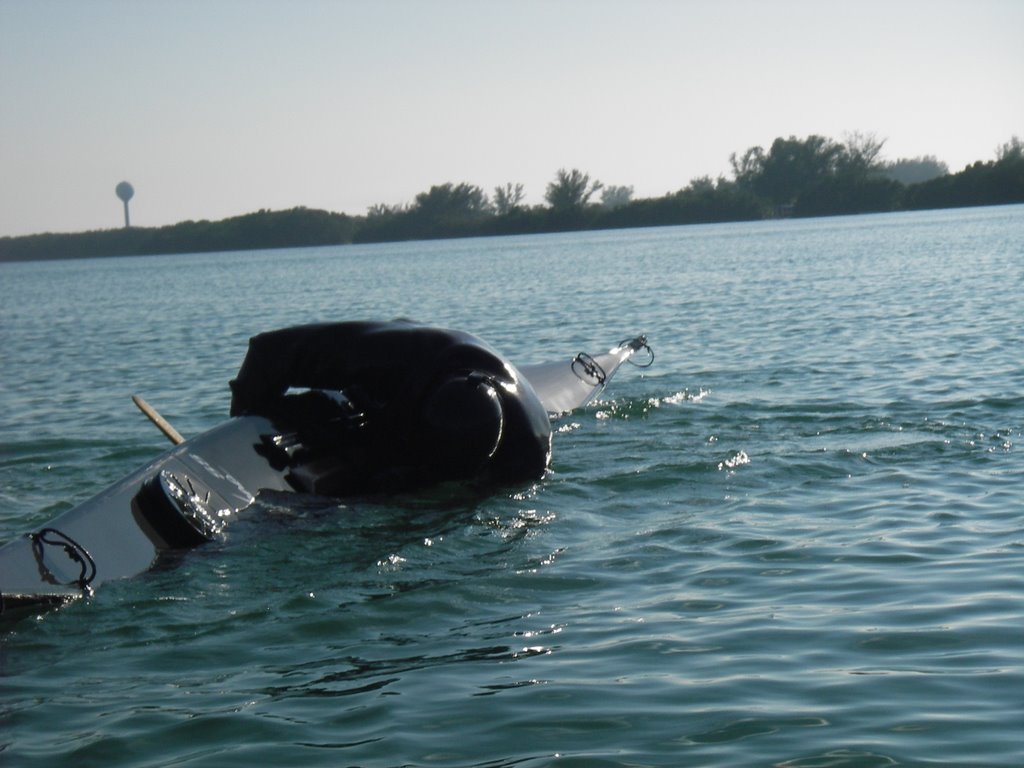
Turner Wilson completing an under-the-deck sculling roll in Freya's breakapart kayak (he loooooved it):

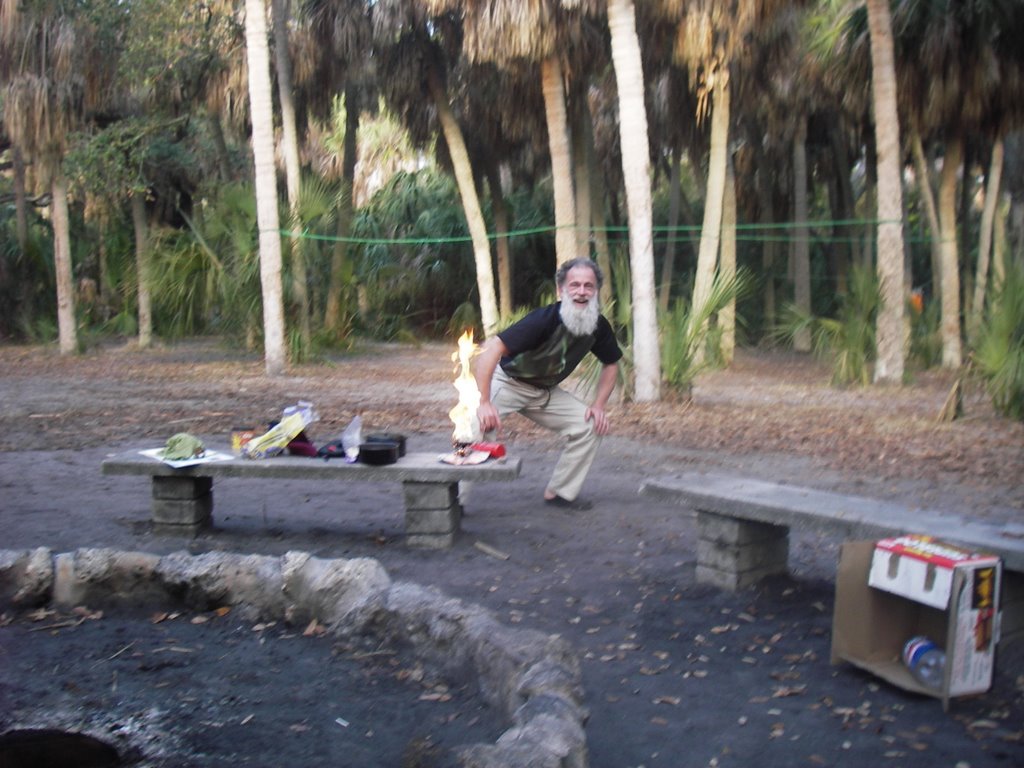
Turner making tea for himself & Cheri:

OK, OK, one more to finish this up - I'd meant to do this & the last in one post but I was having fun surfing the net looking for info on the histories of the different kinds of paddles, got more into that than I planned too. I was going to leave it at that until tomorrow at least BUT I went and made it sound like some big cliffhanger, so now anybody who read it probably thinks that Turner let me in on some big magic secret of the Greenland stroke and I'm just holding out to be coy before revealing all. Thing is, "coy" is not part of the human-relations vocabulary I'm comfortable with, I'm a pretty straightforward person & not fond of beating around bushes. I can, however, get distracted into wandering around bushes & examing, oh, interesting stones & small striped lizards & things in a way that could be mistaken for bush-beating.

So I want to end the suspense because the longer I leave folks in suspense, the more annoying it's sure to be when I do & it turns out to not really be all that dramatic a secret!

In fact - the incredible, astonishing, amazing, eye-opening thing that Turner said to me during my first-ever lesson in the forward stroke was simply this:

"The push happens after the blade passes your hip".

We'd started out the afternoon as part of a larger group who were being taught control strokes by Greg Stamer. There were a few minor differences from the control strokes as done with a Euroblade, but differences that the nature of the way a Greenland paddle behaves in the water made feel quite natural. A review under competent eyes never ever hurts, but I was pleased to find that my own independent efforts were not too far off base. As the larger group (which had done their forward-stroke work in the morning while I and a couple other more experienced rollers had worked on our rolls by the beach) moved on to bracing, Turner took me & the other guy who were lined up for afternoon forward-stroke review off to get going on that.

We started out just cruising at a comfortable pace for a little while while Turner watched us. Turner's first pointer was "Cant the blade a little more". I knew just from reading here & there that with a Greenland paddle, you tilt the blade forward a bit for the catch (the moment the blade enters the water) - the paddle automatically dives, but the flotation of the wood counteracts the dive & brings it back up. I'd thought I was doing so, but I needed to exaggerate that more. Actually I should have known that after Sea Level posted a great writeup last fall of a "mini Greenland-fest" (strictly informal) that happened at the barge last fall - we'd both been talking about the interesting way our Greenland paddles seemed to gently vibrate in our hands while paddling, he came up with the description "sloosh, sloosh" - well, Greg Stamer was reading & explained that, uh, that's not supposed to happen, "sloosh sloosh" is the sound/feeling of cavitation (bubbles following the blade) and ideally that doesn't happen. So finding out that I still wasn't canting enough, even though I thought I was doing it, wasn't a surprise at all.

So that cleared up pretty quickly.

The next instruction was a little more push on the upper hand.

That's when he hit me with the instruction that I think actually may have stopped me dead in mid-stroke.

Turner: "The push happens after the paddle passes your hip".

Me:(hearing sounds of screeching brakes & rending metal in my head)"After the paddle WHAT?"

Now I haven't had the chance to really practice the Greenland forward stroke since then, since practicing a new technique is something I prefer to do solo and the conditions on the weekends I've been paddling have been such that I've preferred the safety of "the usual suspects" (as I tend to think of the group of friends with whom I do most of my winter paddling) - but I have a feeling that that seemingly innocuous phrase may have been the key to the detail I figured I must have been missing!

This is also where that whole exigesis with the different planes comes back in, too.

You see, the first fine point of the Euroblade forward stroke that Richard Chen See worked on with me, during my first year at MKC, was that the blade needs to come out at your hip. This is one of those things that I talk about getting from classes - those seemingly minor details that make a major difference, and completely counterintuitive. A stroke that's 12 inches long is going to be more effective than one that's 5 inches long, which is going to be more effective than one that's 2 inches long, so you'd think that the longer the stroke, the better, right? Well, with a Euroblade, you'd be wrong! The fact is that once the blade passes the hip, the angle gets to the point where a lot of drag is being created. I don't know if this is exactly how it works but I tend to be a very very visual thinker, and the picture I have of what happens when the blade passes the hip is that at that point, the blade is actually beginning to angle up towards the surface, and the further that goes, the more your effort is being wasted on shoveling all the water that's on top of that big flat scoop up towards the surface. And water is HEAVY! To maximize the efficiency of a forward stroke with the Euroblade, then, you bring it back only so far, then let it slice out sideways (the same is true of a wing, probably even moreso, only the wing, used correctly, pretty much slices out of it's own volition, you just do the stroke right & don't interfere).

That was a hard thing to learn. Even though I believed what Richard was telling me, it felt absolutely bizarre to get used to keeping the entire stroke in the forward quadrant of the boat. Once I'd trained myself to do that, though, and added it to the nice effective torso rotation that Richard had managed to get me doing before he even started on this, I found myself doing a lot better. With those two pieces in place, it got to the point where once or twice Eric, with whom I was still on good terms at the time, sent me after husky men with high opinions of their abilities...generally they'd get the point that there was something more than muscle involved & be a lot more amenable to listening to pointers after the wimpy-looking chick (I've built up my upper-body strength since then but that first year my arms & shoulders were pretty no-account) cruised past 'em without even breathing hard. Heh heh heh.

Apparently, though, with the design of the Greenland blade being so different that the Euroblade, the blade can and should travel past the hip. I, however, have so thoroughly trained myself NOT to let a blade pass my hip that the concept of even trying such a thing would never have crossed my mind.

I tried it, though, and the boat did seem to be moving through the water with more alacrity. I do need to practice it some but I think the thing I may have been missing all along was nothing less that THE ENTIRE BACK HALF OF THE STROKE!!!

In the immortal words of Homer Simpson - D'OH!

It was a couple of years ago that Nigel Foster first truly made me really start looking at the "why's" of the ways different boats behave in the water (he put me in one of his Silhouette boats & started running me through the basics - I think it was the low-brace turn where I was just about ready to cry 'cause everything that I could do quite confidently in my banana-esque spins-on-a-dime Romany was failing completely in front of this very topnotch instructor - thank God, though, he then explained EXACTLY why I was doing so miserably - that lesson in the basic differences (and the hows & whys thereof) of a long-keeled Silhouette and a rockered-like-a-whitewater-boat Romany was probably the part of that private lesson that was the biggest eye-opener & has stayed with me the longest (AND had me signing up for two full days with Nigel at Sweetwater, too - more of that, please!).

What the water is doing under two different hull shapes, I'm getting better, I think, at picturing. I think I also have a pretty good picture of how the forward stroke works with a Euroblade, and why the forward stroke with a Euroblade is so much of a "front-wheel drive" affair.

Can't quite picture what's going on with the GP yet. Learning this stuff seems to have two stages - first, I just do something 'cause somebody who knows what they're doing tells me too, then gradually I start being able to imagine a picture of what's going on. While still operating within the same basic principals (hello, Bernoulli!) as the Euro, clearly something very very different is going on, 'cause the drag that you get if you use a Euro incorrectly is not a problem with the Greenland.

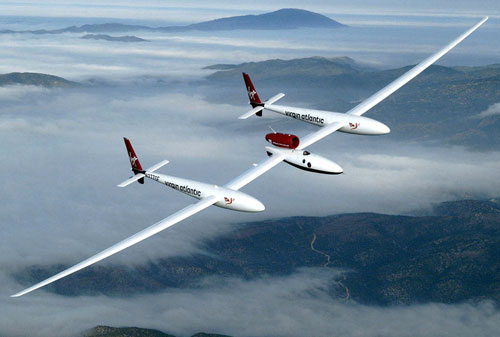
I was hesitating to draw parallels too direct to my planes, but I can't help but look at those long, thin wings of the Global Flyer - wings designed specifically designed to maximize lift and minimize drag - and see a design that looks an awful lot like a Greenland paddle.

Makes me wish I had access to one of those tanks where they test hydrodynamics of things - how cool would it be to do a comparison between the flow of water & the forces generated by those 3 different kinds of paddles?

As it is, what I do have is a dock and a river...if you're in the Chelsea area anytime in the future and you see somebody who's apparently gone completely insane & is trying to paddle a dock moored to a solidly secured barge, please don't call the loony bin, it's just me experimenting with all my different paddles - the fighter plane/jumbo jet pilot trying to learn some Global Flyer secrets, as 'twere. Not going to make any serious claims to sanity (after this series, how can I?), but I can at least promise that I'm at least harmless to myself and others.

BTW if anybody knows of such a thing having been done I'd love to hear about it.

In the meantime I think I will go spend a little more time in this very nifty physics of sailing site. Got some neat little virtual-lab things that might help my visual images of all things Bernoulli-effect-related. That site, btw, was recommended by Adrift at Sea on Tillerman - the Tillerman (and his incredibly well-informed commenters) have been geeking out (NO disrespect meant by that, Tillerman, sir! Quite the opposite in fact!) on the physics-of-sails topic at the same time as I've been doing the same on different paddles...I could just go on all night (in fact I am not even to go into the different handling characteristics of the 3 different Greenland paddles used in the session - Turner has a big solid one, I was using the lighter of my 2, and the other gentleman in the class had a carbon fiber one - we all ended up switching out & the differences were really pronounced).

Past my bedtime, but worth it - now if I really do disappear into a blogging black hole next week while the March books are closed & the budget finalized, at least I haven't left you all hanging. Didn't want to do that!

Friday, March 31, 2006

Of Paddles & Planes, Part II

Yes, one last semi-real post before I vanish into Budget Hell. I should start with a reiteration - a small geek advisory is in effect from now until the end of this post. Scott Chicken was very impressed with the intensity with which I've geeked out on both land and water...well, here we go again!

And as Yellow-Eye said in a comment on the same post - yes, it all comes back to kayaks - and more specifically, to the Sweetwater Kayaks BCU/Greenland Week. This time, my subject will be a really excellent afternoon class on Greenland fundamentals (of the rightside-up air-breathing variety, no less!) taught by Turner Wilson.

I finished my last Paddles & Planes post with pictures of some kayak paddles. Let's go back & look again - this time with a little more explanation. First one note - don't look too hard for direct parallels to the different jobs those 3 different planes specialize in doing, I realize it would be easy to say "Oh, she means paddle A is like plane A, paddle B is like plane B..." and I just want to steer everybody away from that path right now. The only comparison I'm after is that again, we have 3 different designs that all perform a similar task (for the planes, flying, for the paddles, moving kayaks), but in different ways.

Paddle (relevant definition only)
NOUN: 1. A usually wooden implement having a blade at one end or sometimes at both ends, used without an oarlock to propel a canoe or small boat.

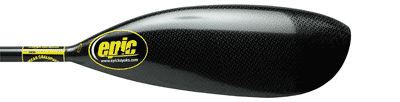
First paddle for today is the wing paddle:

This is a highly specialized, very modern design that evolved in response to one very specific desire - the desire to move a boat through the water as fast as possible. I don't think I've ever seen one that wasn't made from carbon fiber. I've done a quick Google search and can't find anything more about the history of these things than a reference to the "winginess" of their shape becoming "more pronounced over the last two decades" in a Wikipedia article on canoe racing - however I think we can at least take that to mean that the idea is still pretty new. Did you by any chance read Greg Barton's article? That explains in depth. Quick explanation - you put a wing paddle in the water and that curved blade just grabs on it feels like you've planted your blade in quick-setting cement (this is actually why I don't use my wing with my Romany - a Romany is a pretty solid chunk of glass to be dragging around like that & I want my shoulder joints to stay intact for a good long time to come - but with a surfski, whee!)

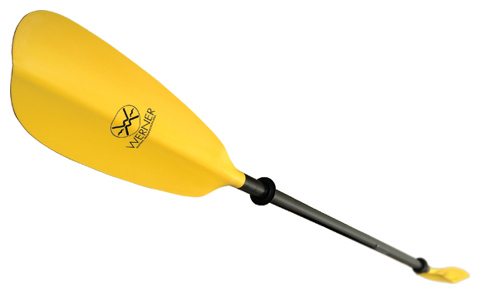
Second paddle is what is known in kayaking circles (where there's awareness of Greenland style, particularly) as a Euroblade:

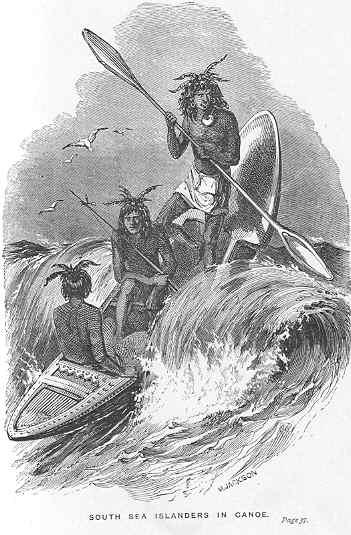
This design - the one that most people would picture if you said "Kayak paddle" - has been around for much longer than the more specialized wing paddle. In fact, I think it might even be a little Eurocentric to call it a Euroblade -
This image is from Chapter III of R.M. Ballantyne's 1863 book, Man on the Ocean, e-book version copyright Athelstane E-Books
Take this design without the double blade feature, and you've got something you'd see all over the world - and something that looks (be warned, I am venturing into pure off-the-top-of-my-head conjecture here) like what somebody might come up with if they'd never seen a paddle before in their life but had a need to make something to propel themself on the water. After all, the prototype is attached to the end of most healthy human arms. You can paddle a boat with your hands; occasionally on a white-water river you'll see a particularly skilled paddler doing so for fun (you can buy gloves that give you neoprene webbing between your fingers for just that purpose); if you want to paddle it faster, doesn't it just make sense to make yourself a bigger "hand" out of wood, making a blade that's broader & longer than your hand & attaching it to a handle so that you can wield it effectively?

Are you with me on this?

OK...if you are, then how the heck did this happen?

This is a West Greenland style kayak paddle (frequently abbreviated to "GP" - you'll also sometime hear these affectionately referred to as "skinny sticks"). There are definitely other varieties of traditional kayak paddles, both single and double bladed (for that matter, if you go to a kayak shop, you'll see a lot of variations on the basic Euro plan, too, that could be a whole future post in and of itself), but this is the one that most people in the US who know a little bit about Greenland style kayaking would picture if you said "Greenland paddle". So why the departure from the basic lollipop layout you see on so many paddles all over the world? Well, the impression I've gotten from listening to Greenland-style paddlers "talk story" is like this: the one catch (ha ha, that's a paddle pun...a pretty bad one though...sorry, it's late & did I mention I'm rewriting this entire post?) to a group's ability to consistently produce paddles with broad, flat blades is that you need a consistent supply of broad, flat pieces of wood. Where the kayak evolved, they didn't have much wood. Plenty of skin, bone, and stone, but the wood supply was mostly limited to whatever the tides & winds brought them - that meant mostly smaller pieces. The response to this challenge was the creation of the long narrow paddle you see above. It may look too skinny to be of much use, but if you'll notice how much of the length of the paddle is comprised of blade, you'll have the answer - the surface area of that blade (known as the "face")may be similar that of the Euro design, it's just stretched out over more length (I just took a quick measurement on the paddle Jack Gilman made for me & the blades on that are each 77cm long; for comparison, a basic Werner Skagit touring paddle has a blade length of 49 cm).

That scarcity of wood is also the reason for another design feature on the paddle shown above - traditional Greenland paddles frequently have bone tips and edges; this is to protect that valuable wood. You'll sometimes see Greenland paddles with simulated bone tips here, but that's generally more among the more serious Greenland replica builders - it looks cool & it's more authentic, but here in a land of wildly abundant 2x4's it's a very optional detail. Similarly, harpoons were designed with detachable heads; shafts were too valuable - and the skin-on-frame design itself allowed boats to be built using a minimum of wood in the first place.

Think that's enough for one night, but here's where I'm going with this:

As I mentioned in my last post, I currently have at least one of each of the aforementioned paddle designs - one wing, two Euros, and three Greenland paddles (a storm paddle & two full-sized, I bought the second as a spare to have in Florida). My first Euro was acquired in 1998, my first year of paddling. I believe I got the wing my second year (first year as a partner at MKC, Eric had gone off to Hawaii in the winter of 1998-99 & Bob Twogood had converted him to a surfski addict & we were all into racing that first year - unfortunately that was also the first year that my racing curse popped up...). I learned to use both of those paddles from very good instructors (the Euro initially from Eric, with significant tuning & refinement from Richard later; the wing from Bob Twogood (I went to visit my folks during the fall of '99, signed up for a private lesson with Bob, he's great). The wing is so specialized you almost really need instruction to get much out of it; the Euro somewhat less so but there are some very counterintuitive details that you would probably never guess left to your own devices.

I bought my first Greenland paddles early in the Spring of 2003. I carry my storm paddle as a spare, and I love to practice rolling with it after a good paddle - but for paddling with my speedy friends (all of whom favor the Euroblade) I always use the Euro. The paddle that gets the 2nd most use as far as covering distance is the wing - I use that with my surfski in the summertime. The GP - well, I've just never found it to be fast enough! I love rolling with it, I'll use it sometimes if I'm just puttering around on my own & don't really care about getting anywhere in particular, and I'll use it if I'm out with people in the "skinny stick" set.

But as far as getting from Point A to Point B - gimme the Euro, in the Romany, or the wing & the ski. Somehow I just didn't seem to be able to get the same kind of speed out of the Greenland paddle, with it's sliding-through-the-water feeling, as I could with the more positive bite of the Euro, or the planted-in-concrete catch of the wing.

Never blamed the paddle, though. You see, I knew exactly what I'd gotten out of lessons with both of the other kinds of paddle - those funny little un-obvious things that when done right let me use both much more efficiently than I ever would have otherwise.

I had a feeling that the same thing was probably true of the Greenland paddle - I'd had hours and hours of wonderful coaching, but that was all on the rolling end of things. The plain old forward stroke? That, I was figuring out for myself.

My experiences with the other two types of paddles told me that when you go at something that way, there's a pretty good chance you're going to be missing some really crucial thing - might even just be something simple, but even a simple thing can sometimes make a big difference. When I signed up for the BCU/Greenland week, one of the things I was really excited about was to finally fill in that gap in my learning, and see if there was something I was just plain missing.

My first afternoon at Sweetwater, therefore, was that long overdue Greenland basics class, taught by Turner Wilson.

Basics might sound boring, but it wasn't. Not a bit. And my just-plain-missing-something theory was just plain right.

Thursday, March 23, 2006

Of Paddles and Planes.

Well, I think it's about time to get back to those planes I showed you the other day!

Airplane -
NOUN: Any of various winged vehicles capable of flight, generally heavier than air and driven by jet engines or propellers. of various winged vehicles capable of flight, generally heavier than air and driven by jet engines or propellers

Various indeed!

Here are my planes, once again - this time with a bit more of an introduction. Look at the wings! The thing I wanted to point out here was the designs of the wings - the different way that air behaves as it moves over the various wing shapes gives each plane some very specific flight characteristics.

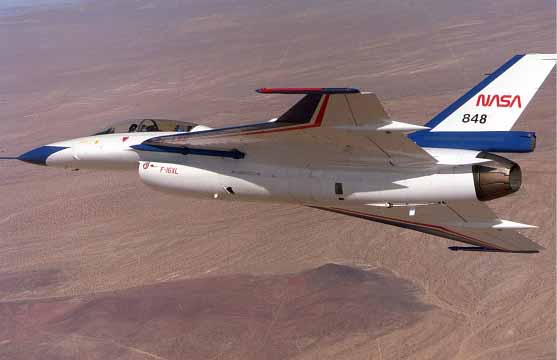
My first plane is an F-16. This plane has relatively short little wings which are swept & they have what airplane people call a "low aspect ratio" (at the risk of oversimplifying to the point that makes the airplane people hate me because it's not quite right, think relatively short leading edge of the wing compared with the overall area of the wing). The way air moves over a wing shaped like this allows this plane to be extremely fast & manueverable, although at the cost of efficiency (gas mileage? ha!).


My third plane (I'm taking them out of order to go from one extreme to the other) is the Virgin Atlantic Global Flyer - I had actually meant to find a picture of Voyager, the plane in which Dick Rutan and Jeana Yaeger completed the first ever non-stop no-refuel flight around the globe, but I got the names mixed up. The Global Flyer is fine as an example of the opposite extreme from Plane #1 - long, straight , slender wings, rather like a glider. This plane will never break the sound barrier, and in an aerobatic competition the F-16 is literally going to be able to fly rings around this one - but what those high-aspect-ratio wings do is generate an enormous amount of lift, with the least possible drag - incredibly efficient (think about how long a glider can stay aloft with no fuel at all, once the towplane lets it go). The F-16 is going to run out of gas when the Global Flyer has barely begun to fly. You see those same kind of wings in nature on albatrosses - they may look goony on takeoffs & landing but once they're up there they just float.


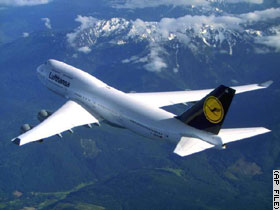
My middle plane, then, is the 747 jumbo jet - balancing speed, manueverability and range by a wing design midway between the two high-performance extremes, resulting in a reliable workhorse of a jet.


The whole point of all of this, though, is pretty straightforward - what I wanted to show in these three types of aircraft, each well designed for the task it's designers meant it to do, was an example of human ability to take a certain piece of technology & adapt it in ways that maximize one performance characteristic or another, based on the job to be done. I picked airplanes - I could have picked skis, or saddles, or anchors, or houses, but I guess that somehow I see a lot of connections between the various ways that we move boats through water and the various ways that aircraft move through the air (after all, it's no coincidence that airplanes use the same port & starboard lights as boats) -- particularly after a couple of days with Nigel Foster got my head all stuffed with words like turbulence, laminar flow, and pressure differentials...hydrodynamics, aerodynamics...they seem to flow together (pun entirely intentional & I do apologize).

at any rate, now it's time to bring this post home to paddling --

or more specifically, paddles!

A much older technology than planes, but just like airplane wings, a technology that's been adapted in many, many ways to provide different performance characteristics tailored to different desired results - whether those results involve hunting seals, or hunting gold medals.

So here we go again:


Paddle (relevant definition only)
NOUN: 1. A usually wooden implement having a blade at one end or sometimes at both ends, used without an oarlock to propel a canoe or small boat.

This is a paddle:


This is also a paddle:


This is also a paddle:


And although I do mean to continue following this meandering train of thought, I think this is enough for one night & one post!

I'll close with a few links (careful, I could have read these for HOURS...)

If you want to read more about airplane wing aspect ratios, Wikipedia's got a great article - whoever their contributers were, they manage to describe the physics in terms that a person who's never taken a physics class in her life (i.e., me) could understand - that's the one where I really think I could've followed the links all day, from swept wings to the v-formation of migratory birds (they're drafting...) and so on and so forth - anyways, the article's here, don't say I didn't warn you. I do recommend the swept-wing link, that and the aspect ratio page actually let me write this post with a little more confidence - I had the general idea but reading those I was actually picturing airflow & for about 2 seconds I actually got it.

If you want to read more about these long-distance record making & breaking airplanes, the Virgin Atlantic Global Flyer site is here, and you can read about Voyager and the original first non-stop non-refueled flight 'round the world at www.dickrutan.com.

and if this whole aeronautical side trip is weirding you out, don't worry, my next post will be (er, at least if I don't get distracted) about my first lesson (taught by Turner Wilson) on how to actually PADDLE with a Greenland paddle!

Paddle images shamelessly lifted from QajaqUSA.org, Rutabaga, and fastkayak.com - plus a really good intro to the wing paddle, with excellent diagrams, by Olympic gold medalist Greg Barton, can be found here - found it while looking for images (truth is, this has been sitting in drafts for a couple of days waiting for paddle pictures - I'd hoped to go to the barge after work & just take pictures of my own, I have at least one of each variety, but it's budget season & there ended up being a ton of work to do tonight, didn't escape 'til after nine, by which time I just wanted to come home...)

Definitions from Bartleby.com

Wednesday, March 08, 2006

Plane to see...

This is a plane:


This is also a plane:


This is also a plane:


Any questions?

Don't worry, I'm actually going to go somewhere with this in the next couple of days - somewhere kayak-related, even. Can't say exactly when as I'm in another one of those long-work-day-causing close weeks (February is just too darned short) and got to go see Richard dance again tonight courtesy of my friend Larry's aunt - she usually takes Larry to watch the PTDC, but this year she had knee surgery & while the recovery is going fine, she's not comfortable sitting right now, so she was kind enough to give Larry the extra tickets & Larry brought his boyfriend Brian (who's a really nice guy) and me! Had the best time, but I am going to pay for losing tonight as a work-late night. Totally worth it, though, loved tonight's program.

At any rate, thought I'd just post this to give you a little something to wonder (even if it's just "OK, has she gone completely nuts now, not that she had too far to go?"). Gotta get some sleep now & between work & a couple of things I've promised to do (fun things, though!), things may get sparse for the rest of the week - but I will come back to this.

might throw in a Dubside story or two for Wenley first, though...